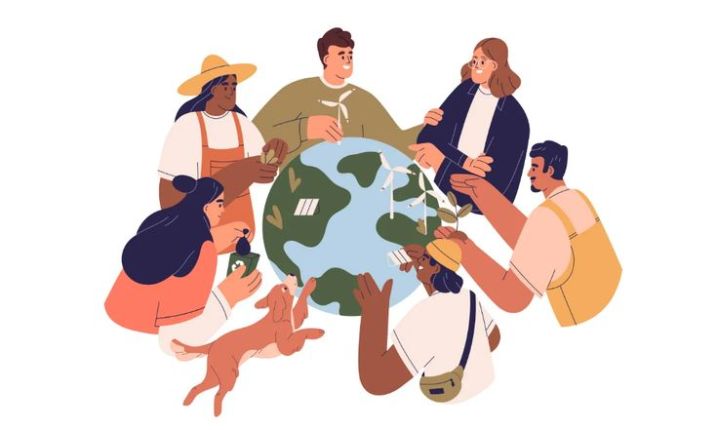
Lynn Margulis’ term holobiont emphasizes the porous connectedness that entities have and even are. What would happen if we leaned into this interrelatedness? What would it look like to cultivate habits, practices, and spaces that enlivened our understanding of being interrelated? Perhaps this intentional cultivation could help us become more permeable listeners, learners, and enactors.
Bruno Latour: Cherishing Kafka’s bug
I first learned this term holobiont in Bruno Latour’s After Lockdown: A Metamorphosis (2021) (1). This astonishing book—as innovative, humane, funny and searing as all of Latour’s books are—flips the familiar interpretation of Franz Kafka’s character Gregor Samsa, in the novella The Metamorphosis, on its head. This human-turned-bug character is usually seen as a degradation, a helpless creature trapped in a morally inane and capriciously cruel society, or slightly differently, an embodiment to show how absurd modern norms have become such that, even after being turned into a bug, Gregor is worried about how to get to work. Latour’s Gregor, instead, emerges as the lucky more-than-human entity that can register and lean into its interrelatedness far better than the empty-headed human caricatures surrounding him.
What does this interrelatedness mean; what do we learn about it in Latour’s interpretation of Kafka? It means that the concept of the individual, especially at a microbe level, is more myth than reality. Selfishness doesn’t ensure survival, Latour argues, since we need entities beyond the self to breathe, digest, and grow. What is more, being earth-bound terrestrials ought to impel us to look after the Earth and those we share it with. Latour writes,
You’re not in your old room now, Gregor, but you can go anywhere, so why would you hide away in shame? You fled; now take the lead; show us! With your antennae, your articulations, your emanations, your waste matter, your mandibles, your prosthesis, you may at last be becoming a human being! (3)
The more we creatures open ourselves up to our connectedness, the more we are living in recognition of who we are and how we operate. This is the invitation of becoming holobionts: “Lynn Margulis has suggested replacing the too narrow notion of an organism by what she calls ‘holobionts’. Holobionts are a collection of actors in the form of clouds with blurred contours that allow somewhat durable membranes to subsist, thanks to the help the exterior contributes to what is held inside” (4).
Affect Each Other, Get Attached, Be Moved
Latour’s thinking has been partly shaped by the French philosopher Gilles Deleuze, himself a major progenitor of affect theory, which grapples with how and why we affect each other, especially at sensory, limbic, and emotional levels—and in time, as experience coalesces and shapes our perceptions, in our structures of ideas and judgments. In this, our very cellular, molecular, atomic entwined-ness plays out not only in atmospheric or ecological ways (how a room can change when someone walks in), but can with time and exposure change the way we think about things (as in, how a relationship with that person can transform our opinions).
Deeply informed by Latour, literary theorist Rita Felski has also pursued this line: our ability to be affected by things beyond us, particularly in Felski’s case a fictional character or a painting or song, will shape not only the content of our beings, but how we relate this content with other beings. Our attachments, which are at least as much in zones of affect as cognition, will (re)create our faculties of attaching—of seeing, interacting, and co-making (5). In The Enchantment of Modern Life: Attachments, Crossings and Ethics, the philosopher Jane Bennett likewise writes about attachments, about allowing ourselves to be enchanted in such a way that we are swept up enough by something else (human, more-than-human) in our webbed existence so that our ethics—our ethical ability to respond to those in plight—are informed not by route or obligatory moralism, but by affection (6). This is not a quantitative “add-on” of kindness; this is a qualitative shift in the kind of kindness we extend, dependent upon how enraptured we have experienced ourselves to be with the reality of another. And what do I mean by kindness? I mean anything from getting off our phones (or out of our daydreaming reveries) at the checkout counter to at least look at the face of the person at the register; to contacting local politicians when their anti-immigrant rhetoric edges toward xenophobia; to scattering wildflower seeds for the bees.
These thinkers—Latour, Felski, Bennett—are exposing the major ingredient needed for our bio-physical interrelatedness to actually affect our being in the world, our personhood as shared with others: the willingness to register this interrelatedness. I’m not sure that registering our interrelatedness necessarily moves toward lifestyle changes (e.g. going vegan or no longer traveling by plane)—at least for the space of this essay, I wouldn’t aim quite so directively—but what I am interested in is what happens when we do recognize and cultivate our awareness of our interrelatedness.
“Bread on the Table”
Here is a poem by the Croatian poet Dragutin Tadijanović, entitled “Bread on the Table” (1984):
To stand in front of a white sheet of paper,
Not a single word on it, and know:
Men have written so far millions of poems
In all the languages of the World
And for millions of people on Earth
There is a weapon ready to destroy them —
But you want your cry to be heard as well:
Peace to the World! Freedom to the World!
And let there be bread on the table for all! (7)
This poem moves from the courage of art-making and communication (writing poetry and reading it) to its vulnerability in the face of nuclear destruction; it then, in line 7, circles back to that courage and infuses it with the cry for peace, freedom, and bread. Nine lines encapsulate the need for communication and for food, despite or even because of the destruction that humans make. Putting this poem in dialogue with the call to interrelate, to become the holobionts we are, the idea emerges that if another is not able to communicate and not able to eat, the shared ecology we live in suffers.
Inspired by these words, I start to think that if we don’t afford ourselves the experience of connectedness, of being affected, moved, enchanted—we will never find our way to acting like a holobiont, even if in fact we are one. Our imaginations, our opinions, our research, and our actions will suffer the affliction of never being-in-response, never becoming a response that is needed for care, repair, and goodness. This being-in-response is taken up in creative ways by Donna Haraway, who argues that our “response-ability” must stick with the trouble that our Earth is in now, in the present, a response arising from the “kinship” we share as multispecies:
Staying with the trouble does not require such a relationship to times called the future. In fact, staying with the trouble requires learning how to be truly present, not as a vanishing pivot between awful or edenic pasts and apocalyptic or salvific futures, but as normal critters entwined in myriad unfinished configurations . . . (8)
In Zulu, the term-concept Ubuntu can be understood as, “I am because you are.” This dynamic may be true at levels of climate, viruses, and microbes, but does it play out in our everyday interactions with other creatures? Can we cultivate enough interactions to find something kindred—the value of joy in climate activism; the treasure of children; the importance of bread?
Writing Our Affective Ecology: Making New Words, Undoing Metaphors
I recently participated in one of the most innovative and enriching of writing workshops, entitled “Writing Emotion in the Anthropocene.” Led by the researcher and artist Dr. Susan Wardell from Aotearoa New Zealand, who drew from her work in affect theory and creating a speculative lexicon for climate emotion, we were given the space to explore our own histories of interaction with nature, seeing if we can circle around new words and undo old metaphors. This was in part to pry open the interrelated experiences we have with things beyond ourselves, to learn and be shaped by our webbed-ness.
In the course of the workshop, responding to several prompts, I came up with the word ‘egglossia’: the state of being reconciled with being broken. Beyond the obvious egg is the word gloss of the egg itself, the sheen of raw egg; the word loss, hinting to the sense of loss of that round egg shape, whole in its shell, when it breaks open; and glossia, the words that pour forth when we do break open. This speculative play—reflective, in-process, joyful—is a fascinating example for cultivating our interrelatedness in that it shows how my very word usage can be shaped by the affective ecology I am part of, if I take the time to work and play in response to it. This is perhaps a felicitous accompaniment to our thoughts about responsivity. It is serious work, and it can also be delight and play.
Connecting back to Latour, it’s interesting to put this in conjunction with these words from After Lockdown:
[M]y diction is in danger of sounding like mumbling, that’s the whole problem with this becoming-animal. But what counts is to make heard the voices of those groping their way forward into the moonless night, hailing one another. Other compatriots may well manage to regroup around those calls. (9)
I imagine that leaning into our interrelatedness, becoming the holobionts we are, will for a long while feel like “mumblings” as we “grop[e] forward into the moonless night”—especially as we’re trying to register multispecies kin and more-than-human connections. I think it’s uncomfortable because not only does it de-center narratives, but our very use of words get inflected, perhaps tuning more rudimentary for awhile as we mumble through new ways of making value.
Spending time in the thick of this webbed-ness, though, might mean that real plights of fellow holobionts—another human’s lack of bread, what the ocean waters suffer with waste, when lines of communication are brutally severed—becomes unendurable for us, only seemingly afar. That, I think, is the hope.
So let us cultivate and nurture our interrelatedness. Let us dream up and push into what this cultivation means at this specific juncture in time. Is it being as sensitive as the antennae of a bug, sensing out crumbs; it is scratchings against a wall, to what might be on the other side?
Jessica Brown
References:
- Bruno Latour. After Lockdown: A Metamorphosis. Translated by Julie Rose. Medford, MA: Polity Press, 2021.
- Latour, After Lockdown,
- Latour, After Lockdown,
- Latour, After Lockdown,
- Rita Felski. Hooked: Art and Attachment. U of Chicago P, 2020.
- Jane Bennett. The Enchantment of Modern Life: Attachments, Crossings and Ethics. Princeton UP: 2001.
- Dragutin Tadijanović. “Bread on the Table.” Na stole kruh / Bread on the Table. Translated by Dennis Ward. Zagreb: Školska knjiga, d.d., 2005. 49.
- Donna J. Haraway. Staying with the Trouble: Making Kin in the Chthulucene. Durham: Duke UP, 2016.
- Latour, After Lockdown,
Leave a Reply