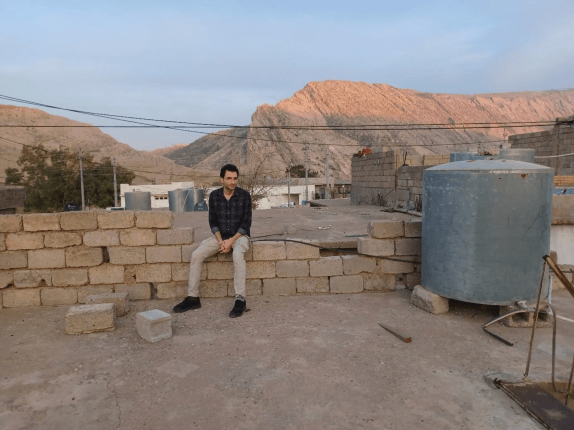
My essay is about visiting the Kurdistan Region of Iraq in March 2023 after an absence of over a decade, exploring the difficulty of shopping for a pair of shoes, visiting my childhood home, and pondering on the question of history and childhood adversities. Within the story, I show the evolving dynamics of my relationship with my family, some aspects of market economics in the region, snippets of the Kurdish exodus in 1991, and attachment to homeland.
As I approached Slemani city in the Kurdistan Region of Iraq one evening in early March 2023, I sensed that my shoes were going to give me trouble. The dark clouds in the sky looked like a saturated fabric being rung, showering the fields, hills, and mountains with ferocious rain—the deluge of ancient civilizations and religions. The deluge, said to have drowned the whole known world, is suspected to have happened in or near my homeland. Upon reaching my sister’s house, I darted from the car to the veranda. Although the short distance saved my Sketcher sneakers—one-size too big, from which my feet kept slipping out—from getting soaked, some rainwater seeped in.
I then caught a glimpse of a kitchen packed with my family—my mother, my three sisters, my eldest brother, my sister-in-law, and my four nieces and three nephews, some of whom I was going to meet for the first time—all waiting to greet me. I had been living abroad for over a decade, first in the States, then in Canada. My slightly wet socks ceased to preoccupy me. Two of my early and late adolescent nieces filmed me with their cellphones as I hugged my tearful mother and then continued to embrace the rest.
I was invited to sit down on the carpeted floor in the living room to join the family for dinner. Not everyone had waited for my arrival, delayed due to the rainstorm. My eldest brother, who had already indulged in the homemade Kurdish kifta and seemed delightfully sated, sat on a couch. His towering status in the family, ever since our father’s death thirty years ago, was announced yet again by his elevated position compared to the rest of us on the floor.
“What’s wrong with your socks?” my eldest brother inquired of me as he pushed his glasses up the bridge of his nose. His eyebrows tensed, a mannerism he adopted whenever he sought to project authority.
I was wearing mismatched striped socks, a habit I developed to make the seemingly mundane necessity of wearing socks more interesting.
Feeling joyful, a result of the dopamine release from the reunion, I asked sincerely, “You like them?”
He shook his head, not in negation or out of indignation. Rather, I suppose, he was surprised that, instead of challenging him, I had chosen to sand off the rough corners of our exchange. He then smiled broadly, and under the glow of the fluorescent light I saw the changes twenty years of marriage and the fathering of two daughters had wrought upon his balding head, gleaming forehead and cheeks, and protruding sack-like belly. He was no longer a shut oyster shell with a serious demeanor. The trials of time and fatherhood seemed to have cracked open his shell, revealing a hidden softness. Yet, like raw food, he still required seasoning, that extra pinch of something to make him more approachable. In his case, it was humor and alcohol.
He rose and went to the kitchen, where he sat at a table, poured himself a drink, and invited me to join him. I said I would soon enough.
While I was still seated with my family around the tablecloth on the floor, where tea was now being served, I voiced my concerns about having arrived underprepared.
“Where can I go to buy a pair of shoes?” I asked. I had flown from Canada with only two pairs of shoes, partly to minimize my luggage and partly because I was following the advice of a friend who had told me I could find a nice pair of shoes at home for a reasonable price. I might have been baptized—perhaps unwittingly—into North America’s consumerist spirit of cherishing sweet deals whenever and wherever possible. But deep down, I was hoping to find a pair of shoes that could rekindle a lost connection with my homeland. I don’t recall a time when I had felt comfortable and happy about wearing a pair of shoes. As a child, due to poverty, my family bought me cheap shoes a size or two too big—“they would fit you perfectly next year,” my mother used to say. And as an adult, the need to leave my homeland was getting so distended by the year that I never considered wearing a pair of treasured shoes that would connect me to the land under my feet. But after all, aren’t our shoes the main point of contact with the ground beneath us?
“I’ll take you to a mall tomorrow,” my hosting sister said. The mother of four—two girls and twin boys—she was well on her way to becoming the family matriarch.
The next morning, once the torrential rains had subsided, my sister drove me to Family Mall, a recently opened three-floor shopping center that resembled any other large mall. We passed through a full-body scanner, and a listless security staff superficially searched my sister’s purse.
Among the strategically located and enticingly advertised stores were the fashion company LC Waikiki, the clothing companies Koton and DeFacto, and the fashion footwear brand Flo—names unfamiliar to me until then. It was only later that I discovered they were all, along with other stores in the mall, Turkish companies. Turkish exports to Iraq are estimated to be in the billions of US dollars annually, with footwear exports reaching into the millions.
I tried several pairs of shoes, but they either didn’t fit me snuggly, or I found a feature not to my liking—slippery soles, lack of arch support, subpar material. There I was with my acquired North American expectation of finding a pair of shoes that was functional, durable, and elegant, while also being averse to the simple categorization of athletic, casual, or formal. I left the mall feeling disillusioned. My sister promised she would take me to a local shoe market where I would “definitely find a pair.”
A few days later, I traveled to my hometown, Darbandikhan, a small town in the north of Iraq, close to a lake by the same name and only 70 kilometers away from the border with Iran to the east. I was intending to visit the neighborhood and the house where I grew up, which I hadn’t seen for over two decades. To help cope with my anxieties, I asked a friend to accompany me. After all, scenes like endearing birthday celebrations, loving childhood friendships, and lush lawns with immaculate streets are absent from my memory because they were also absent from my childhood.
My friend and I walked through the small tight alleys, sometimes wide enough for only the two of us to walk side by side. In some parts, the concrete boundary walls of the opposite houses had caved in, forcing us to walk in single file. The empty spaces and dirt paths of the past had been replaced by underserviced paved roads, skeletal storage stores, and some new small houses that appeared to have been built for shelter rather than establishing a home. That there were no signs of new infrastructure or major renovations indicated to me that the isolated changes in the neighborhood had not been collective, organized efforts.
In the late afternoon, some solitary women were sitting on concrete doorsteps, passively eying the passersby, perhaps waiting for the return of their male relative from work. Some children were also hanging out, listless and disinterested in the deflated soccer balls scattered in the middle of the alleys. I recognized my childhood in them—no after-school activities and no imagined future to strive for. As I had witnessed firsthand, rarely does anyone prosper in such a place. The best one can do is survive unscarred.
“It would be hard to find any Kurdish families living here now,” my friend said. The previous families had built new houses in other areas of the town and relocated, and Arab families from other parts of Iraq had moved into the neighborhood, Mulberry Spring, in search of a little bit more security and stability. Sprayed on several of the houses were signs in Arabic that stated, “For sale,” or “For rent,” followed by a phone number.
The closer we got to my childhood house, my anxiety grew. I recognized the corners where I had been bullied and called a sissy, the narrow alleys where we kids got into stone fights with kids from other neighborhoods, and where thieves were chased at night during the hardship years in the mid-1990s due to United Nations sanctions on the country.
Once we reached the house, it struck me how small the main steel door looked in contrast to my memory of it. This was the door that for me once separated the safe from the unsafe. Now, at six feet and three inches tall, to enter through the door I would have to stoop. The house’s concrete boundary wall, which I always struggled to climb over whenever the door was locked and I had to seek safety from danger—a fight, a threatening stray dog, a crazed person taking a delirious stroll, and so forth—now stood at head height, and I saw myself grabbing its top and pushing and pulling myself upward, climbing it with ease.
The door was ajar; a moment of happiness dispelled my previous worries that I had made the trip without being able to see the house’s interior. I knocked and said, “Hello?” out of habit and as a courtesy; otherwise, it was clear the house was vacant and derelict. I entered, and my friend followed.
aspects of market economics in the region, snippets of the Kurdish exodus in 1991, and attachment to homeland.

The house was tattered and in a state of disrepair. Cracks had crept into its walls, much like the wrinkles now on my face. The gray paint on the window frames and the doors had chipped off, similar to my now receding hairline. The house had aged, as had I.
The inside doors were locked. The windows were glassless. I peered into the dark corners of the rooms. An eerie quiet lurked inside, as if the people who once lived there had fled, leaving only invisible whispers that I could hear if I stayed long enough.
Shards of glass, bits of metal, and pieces of rocks and stones littered the large courtyard. The scattered clutter made the house look like it had been hit by the shock wave of an explosion. I was afraid that I would inadvertently step on a sharp object and injure myself, as had happened many times when I was a child. Fortunately, I was wearing ankle-high Columbia hiking boots that were also one size too big. I hoped their rugged soles would protect not only against glass but against nails as well. In contrast to my childhood slide sandals and sneakers – the parts of which were most probably glued together in ramshackle factories in Turkey and Iran – I felt safer in my hiking boots.
I was in the house where, one night in early April of 1991, my family gathered some blankets, bags of provisions, and personal items, hopped into a car and drove to the nearby village of Bani Khelan. From there, we joined hundreds of other families and marched for six hours to cover the thirty-kilometer distance to the Iranian border. We were fleeing from the fear of chemical attacks and other retaliations by the Iraqi regime in response to the Kurdish uprisings earlier in March.
It rained the entire night of our journey. The incessant downpour not only rendered the roads slippery but the rising floodwaters also carried some people away. At one point, my mother, who was carrying me on her back, slipped, and I fell with her. Terrified by the fall, I refused to be carried any more, and I walked several hours for the remainder of the journey. I was three and a half years old, and most of what I remember consists of the families walking in a line along the road, cars moving more slowly than the people, the continuous rain, and the mud.
In that same spring of 1991, my family of ten was among the more than one million Kurds who fled toward the borders of Turkey and Iran, where we would spend several months in refugee tents and camps. The region was not unfamiliar with such exoduses. As far back as the reign of the Assyrian king Tiglath-Pileser III (744-727 B.C.), several mass-deportation campaigns had been orchestrated, during which hundreds of thousands from different lands were resettled. One particular campaign stands out, as local governors were advised to provide the deportees with shoes—a tyrannical humane act to make the cruelty more bearable (1). When earlier this year the US president Donald Trump spoke of relocating the inhabitants of Gaza in Palestine, resettling them in neighboring countries in order to turn the enclave into “the Riviera of the Middle East,” it was easy to recognize the echo of authoritarian desires in his words, actions which have long plagued people in some parts of the world.
Back in my childhood house, my friend and I climbed a metal ladder to the flat rooftop, where I used to sleep with my family on summer nights on beds arranged on metal frames. The rooftop, which used to accommodate my family of nine, seemed smaller than the spacious rooftop in my memory. Still in place was the hip-high parapet wall that I used to lean over as a child. At the beginning of each autumn, when people were usually desperate for rain, groups of children would parade in the alleys holding up a handmade doll on a cross-shaped frame—just like a scarecrow—and I would spray or pour a bucket of water over “The Doll of Rain”, while the thrilled children sang at the top of their voices: “Oh, friends and loved ones, may it rain for the impoverished and the poor!”
aspects of market economics in the region, snippets of the Kurdish exodus in 1991, and attachment to homeland.

Also intact and impervious to the passage of time and the change of ownership was the three foot high rebar that shot up in one corner. I remember it as the spot where we used to tie my family’s medium-sized white dog—the dog that we had to give away because appalled neighbors claimed it was defiling our household, refusing to even set foot inside our courtyard.
On the horizon were the mountains that half encircled the town. The sun had started to set. Dogs were barking in the distance. My friend and I took some pictures, climbed down the ladder, and left.
I was grateful that my friend had accompanied me, and relieved that the visit had gone relatively well. My hiking boots had done their job, and my feet were unscathed. Still, I needed another pair of shoes to wear for social visits and gatherings, a pair of shoes that would make me feel a connection to the land. I looked forward to my next trip with my sister to the market with some apprehension.
My sister parked her car in a small garage near the iconic square known as Bardarki Sara at the heart of Slemani. Both she and I were caffeinated, and as we walked energetically on cobblestone sidewalks, absorbing warmth from a prenoon sun, we radiated a confidence that proclaimed, This is going to be a successful shopping trip!
The shoe market consisted of a long row of individual stores facing each other, displaying all sorts of shoes on multiple shelves. I avoided the outgoing store owners, who beckoned us to approach and invited us to go inside their store. When I shop, I like to take my time looking at the items, touch them, try them out. I don’t believe any of the common shopper profiles, such as The Browser, The Indecisive Patron, The Researcher, or The Wanderer, apply to me. I prefer to be called The Ruminator.
My sister and I went into a few stores whose quiet and seemingly reclusive owners were more to my liking. I had narrowed down my options to ankle-high boots. I put on several Chelsea and dress boots, but they were too tight. With all those years of buying a bigger size than needed, the habit had stuck. Even now, as an independent adult without the possibility of my feet growing, I tend to buy size 13 shoes instead of 12. Just in case.
The shoes at the shoe market, with brand names like Ecco, Gucci, and Sorel stamped on them, weren’t genuine; they were imported fakes from Turkey, Iran, and China. And after visiting several of the stores, it became apparent that they all carried the same types of shoes. I gave up.
“There is nothing for me here,” I told my sister.
“Let’s go to the second-hand bazaar,” she suggested.
The nearby labyrinthine thrift market consisted of hundreds of stores that sold imported second-hand clothing, mostly from Europe. I almost exclusively shopped there when I was an undergrad in the city. Back then, I was one of the many disgruntled youths, critical of the governing parties and strict religious customs, who claimed that what tied us to the land was not patriotism or religion—the two main sources for loyalty and pride—but our shoes, our imported, fake, cheap, or second-hand shoes. When I left the region in the summer of 2012 to North America, I wore nothing but a pair of open-toe sandals, convinced I would find shoes at my destination—shoes that would help me forge a connection to the new land. But, fearing to return to my homeland and face censorship and persecution for my criticism of governing political parties and oppressive acts of religion, I lived in the States and then in Canada—where I eventually found refuge—my spiritual predicament was overshadowed by practical and pressing matters such as housing, health, and income.
In Kurdistan, I never wore traditional Kurdish footwear known as klash. Klash are made from compressed cotton and fabric, and they require constant care, aren’t water-resistant, and people mostly wear them during Newroz celebrations. Long ago, shoemakers in the region used to make moccasin-like shoes known as kawsh, which were made from animal hide and were to some degree water-repellent, but the profession has died away, and my generation is unfamiliar with these shoes.
In one of the stores, I put on a pair of brown genuine leather boots—Panama Jack—that seemed to go well with my khaki chinos. They were almost two sizes too big, though. I was about to decline the purchase when I looked up at my sister, seated on a chair opposite me; her face registered dismay, but I also recognized traces of hope from earlier. I couldn’t disappoint her. I reached for my wallet to pay, but she wouldn’t let me. She bought the boots for me, as this had been one of the reasons that she had come with me. To make her happy, I wore the boots on the way back home.
In the days that followed, a couple family friends commented on my boots. By this point, even though the people in my life were familiar with the sight of me wearing large-sized shoes, the second-hand boots must have seemed clown-like. I didn’t care. It was a relief to put shopping for shoes behind me and focus on spending time with my family and friends.
Still, a feeling of disappointment lingered. I didn’t realize it at the time, but hoping to re-establish a sense of belonging with my homeland through a pair of shoes, bought in the region and worn during my four-week stay, was nothing but an illusion. The more I stayed there, the more I felt the former angry and disgruntled me returning, wanting to speak out against corruption, traditional values, and religious expectations that offended individual dignity and freedoms. I realized that, were I to stay long, my life would be in danger.
When I returned to my life in Canada I left the boots at my sister’s. “I would like to wear them the next time I visit,” I told her. She put them under a desk in the spare bedroom on the second floor of her house where I had stayed.
As it is, without experiencing the level of affluence necessary to indulge in custom-made shoes, I have resigned myself to finding the perfect-sized generic shoes. Once back in Vancouver, BC, I finally bought a pair of snug-fitting Blundstone Chelsea boots. I wear them often. They go well with my shorts, joggers, and chinos. In fact, I might get another pair. The next time I visit my homeland, I won’t have to worry about packing several pairs of shoes or about shopping there. If the Blundstone boots live up to their claimed durability, I will travel with them. If not, there is a pair of Panama Jack boots—two-sizes too big—waiting for me at my sister’s. Wearing those boots, I may not feel the connection to my homeland I was hoping for, but this time, they would be shoes kept with love.
Dilan Qadir
References:
- Roux, Georges, “Ancient Iraq”, p.307. 1992.

Leave a Reply