
This article examines how polarized debates on gender erode the space for pluralistic democratic dialogue. As the pressure to adopt unequivocal moral positions grows, the ability to engage across difference weakens. Rather than fostering mutual understanding, public discourse often collapses into moral alignment, leaving little room for nuance, or the deliberative practices essential to democratic life.
On April 16, 2025, the UK Supreme Court ruled unanimously that the legal definition of “woman” in the Equality Act 2010 refers exclusively to biological sex. This means that a transgender woman, even with a full Gender Recognition Certificate, is not considered a woman under that law. While the ruling was only issued recently, it gave formal weight to tensions that had already surfaced in the public sphere. In early March, Edinburgh Women’s Aid, a prominent domestic violence shelter, announced it would no longer admit transgender women — a decision that, at the time, drew both support and criticism, and is now framed in light of the Court’s clarification.
Similar tensions have emerged in other liberal democracies. In the United States, for instance, clashes between state legislation and federal protections on gender identity have turned schools, sports, and healthcare into cultural battlegrounds. In several EU countries, feminist and LGBTQ+ advocacy groups often find themselves at odds over similar issues — raising the question of whether this reflects deeper pressures within liberal democratic discourse.
This controversy did not unfold as a conversation about policy or rights. It became, almost immediately, a battle between absolute positions: safety versus inclusion, feminism versus trans rights, progress versus prejudice. What was lost in the fallout was not only the possibility of compromise but also the space for dialogue.
The public debate on gender today does not unfold in the neutral terrain of facts and their interpretation but in a deeply polarized struggle over cultural authority and the formation of dominant discourse. At stake is not merely the recognition of historically marginalized identities but the very terms in which recognition is granted, denied, or rendered mandatory. In this context, dialogue becomes increasingly difficult: positions harden and listening recedes. Further, the human quality of the political subject — the capacity to narrate, to doubt, to seek understanding — is often lost in the din of categorical certainties.
One of the clearest casualties of this dynamic is our ability to engage with the complexity of gender. Gender is a complex, multidimensional social concept: partly biological, partly social, partly individual, and it has different meanings in different contexts. Yet the richness of this formulation rarely survives public controversy. Instead, the discourse is flattened into binary oppositions: for or against, progressive or reactionary, inclusive or transphobic. The result is not emancipation through clarity, but paralysis through polarization.
This shift has consequences. It moves the conversation from the ethical register of interpersonal respect to the political register of discursive domination. In doing so, it narrows the space for pluralism. Drawing on Michel Foucault, we may understand dominant discourse not merely as the prevailing opinion but as the institutionalized network of knowledge, norms, and power that establishes what counts as legitimate speech. (1)
Building on this understanding, Stuart Hall’s analysis of stereotypes provides a nuanced understanding of how discursive power operates through symbolic regulation. Far from being mere simplifications, stereotypes serve to fix difference within asymmetrical hierarchies of meaning and value. (2)
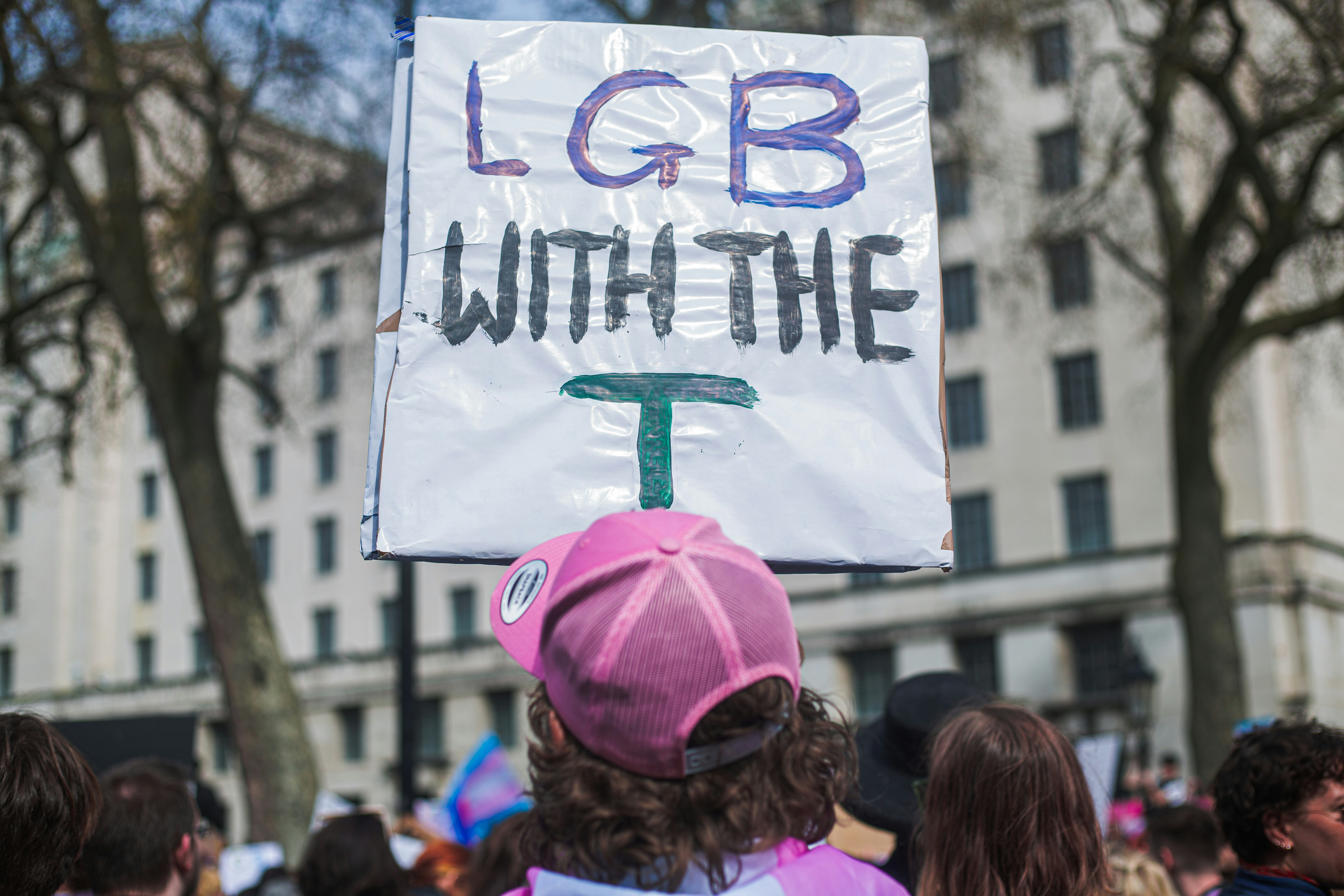
In contexts of heightened polarization, this logic can be inverted: expressions of ambiguity or dissent are themselves stereotyped, reduced to signs of deviance or regression. As the field of meaning narrows, the potential for open-ended negotiation diminishes — discourse risks folding into a closed circuit where deviation ceases to be a site of critical tension and instead becomes a confirmation of the system’s boundaries.
Ernesto Laclau’s theory of hegemony helps to frame this phenomenon. For Laclau, political identities are formed not through stable essence but through chains of equivalence and acts of exclusion. (3) Every discourse, by asserting meaning, constructs an other, against which its coherence is defined. In the current gender debate, the struggle for discursive dominance often leaves no space for moderate voices that do not fully align with any dominant position.
In such a context, facts themselves become inert. The implication is that more data, more clarification, or more science will not resolve what is, at heart, a contest over symbolic order. When discourse functions as doctrine, questioning can become heresy; when affirmation becomes mandatory, nuance becomes betrayal.
This dynamic was visible during controversies such as Scotland’s gender recognition reform debate and the subsequent backlash from women’s shelters concerned with implications for safety and access. These are not imaginary tensions; they are real-world consequences of differing conceptions of rights and identities. Yet public discussion often lacks the capacity to recognize this complexity. What we encounter instead is mutual pathologization: each side interprets the other’s position not just as wrong, but as illegitimate.
The result is a discursive environment inhospitable to democratic engagement. Anderson and Dewey both emphasize the importance of deliberation not as consensus, but as the cultivation of shared understanding through the exchange of lived experiences. (4) This is precisely what is lost when all dialogue is routed through ideological filters and policed by moral urgency. The person disappears behind the position and experience is replaced by alignment.
Social media exacerbates this pattern by rewarding identity-expressive content, reinforcing group conformity and sanctioning ambiguity. The algorithms of esteem, as Anderson calls them, are designed for performance, not reflection. (5) They optimize for outrage, not comprehension. In such spaces, the question is not what is true, but what signals belonging.
What is needed, then, is not less passion, but more room for uncertainty. The challenge is not to dilute political commitments but to resist the temptation to transform every disagreement into a referendum on one’s moral worth. We must rediscover the political value of ambiguity: the kind of ambiguity that allows people to ask questions without fear, to voice dissonance without being cast outside the bounds of recognition.
The battle over gender is not only about identity. It is about epistemology, language, authority, and culture. It is about the fundamental terms through which society distinguishes knowledge from belief, dialogue from decree. Unless we find a way to talk across those distinctions — to restore the space of the human in the political — we risk turning every demand for justice into a clash of absolutes.
Aspasia Fatsiadou
References:
- Foucault, Μ., “The Archaeology of Knowledge”, 1972.
- Hall, S., “Representation: Cultural Representations and Signifying Practices”, 1997.
- Laclau, E., “On Populist Reason”, 2005.
- Dewey, J., “The Public and Its Problems”, 1927.
- Anderson, E., “Can We Talk? Communicating Moral Concern in an Era of Polarized Politics,” Journal of Practical Ethics, 2022, Vol. 10, pp. 72–103.

Leave a Reply