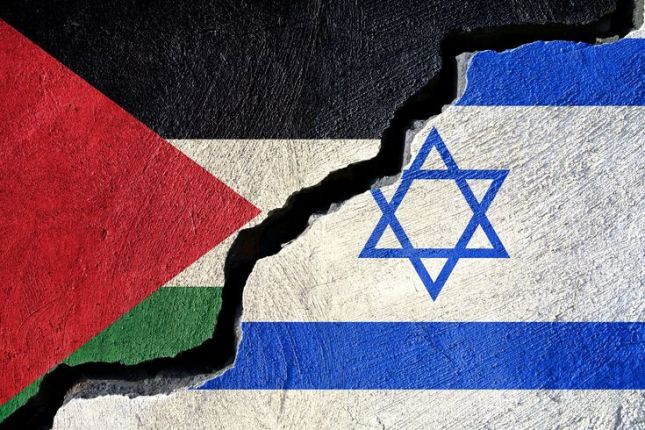
Osama bin Laden’s 2002 “Letter to America” went viral in 2023 amidst heightened public interest in the Israel-Hamas conflict. The letter, since removed from some platforms, critiqued U.S. foreign policy in the Middle East and addressed the Israeli-Palestinian issue by questioning Israel’s historical claims to the region. Exploring bin Laden’s worldview and the sudden surge in the letter’s popularity raises crucial questions about public engagement with complex geopolitical issues in West Asia and the limits of online content moderation.
Osama bin Laden’s “Letter to America”
On November 24, 2002, roughly one year after the 9/11 terror attacks, The Guardian reported on a 4,000-word letter from Osama bin Laden that was circulating among British Islamic extremists. Originally posted in Arabic on an al-Qaeda-linked Saudi Arabian website, British Islamists translated the letter within two weeks and shared it on English-language UK websites. The Guardian subsequently published the full English translation, titled “Osama bin Laden’s letter to the American people,” on the same day. The letter was removed from The Guardian’s website on Wednesday, November 15, 2023.
Why was this letter removed from The Guardian’s website after two decades and what did it contain? The letter advocated for civilian attacks and began circulating on social media in the wake of the Israel-Hamas conflict. Videos dissecting and responding to the letter gained traction on American TikTok, with the hashtag #lettertoamerica exceeding 10 million views by November 16, 2023 – the day after the letter’s removal. In response, TikTok issued a statement condemning such content as a violation of their policy against supporting terrorism and announced investigations into its origin. Meanwhile, The Guardian took down the letter owing to it being shared “without full context”.
TikTok’s community guidelines clearly prohibit the dissemination of content from violent individuals or organizations, including extremists, criminal organizations, and perpetrators of mass violence. They contended that the letter violated these guidelines. White House spokesman Andrew Bates also condemned the viral TikTok videos, stating, “there is never a justification for spreading the repugnant, evil, and antisemitic lies that the leader of al Qaeda issued just after committing the worst terrorist attack in American history”
The letter, since removed from The Guardian’s website, continues to circulate online on other social media platforms. It broadly consists of two main parts, addressing the following questions: Why Al-Qaeda carried out the September 11 terrorist attacks, and what it called upon Americans to do in response to their government’s actions.
Addressing the first part, bin Laden wrote in the letter that the 9/11 attacks were a retaliatory measure against American support for Israel, and was more broadly a justified response to aggression targeted towards Muslims in various regions around the world, including Somalia, Chechnya, Kashmir, Iraq, and Lebanon. In the letter, bin Laden also condemned the existence of Israel, calling it an “unerasable crime” and went on to challenge Israel’s historical claims to Palestine.
In the second half of the letter, bin Laden called on all Americans to surrender and submit “completely” to Islam. He further urged them to cease what he perceived as “oppression, lies, immorality, and debauchery” prevalent in American society. This included his objections to homosexuality and the permission of usury, which he alleged had allowed “Jews to take over the American economy”. Bin Laden goes on to comment negatively on women’s rights, asserting that America exploited women as consumer products, using them to “serve passengers, visitors, and strangers to increase profit margins“, all under the guise of women’s empowerment.
Bin Laden’s letter concludes with a solemn warning to Americans. He cautioned that failure to heed al-Qaeda’s message would lead to their “total defeat,” encompassed by military, political, ideological, and economic downfall. He ominously stated that not even civilians would be spared in this endeavor.

Deconstructing the Letter
Bin Laden’s letter is dangerous. It spreads harmful stereotypes about Jewish people, the LGBTQ+ community and falsely portrays women’s participation in the workforce as exploitation. However, it’s most concerning element may be its oversimplification of the Israel-Palestine conflict. This is important to debunk in the content of the current conflict.
Bin Laden ignores the complex historical claims of both sides and reduces them to a simplistic anti-Israel narrative. For instance, historians such as Neil Caplan point out that both parties have legitimate claims to the land, rooted in their intertwined histories and religious narratives that deserve interrogation. Both parties evoke a largely religious past, one that was passed down through generations via written texts, oral tradition, and education, with each side aiming to prove that their ancestors were there first, or that the land was promised to them by God. Any reasonable claim to land ownership must thus contend with both versions of history.
In his book, The Israel-Palestine Conflict: Contested Histories, Chapman also points out that Abraham had two sons, Isaac and Ishmael. Despite their wanderings, dispersion, and forced expulsions over the centuries, Jews claiming descent from Abraham through Isaac and Jacob have argued that they have maintained a continuous presence in the land, albeit for long stretches in reduced numbers as a minority community. On the other hand, Muslims recognize a common ancestry and spiritual heritage in most of the Hebrew prophets, including Jesus in this lineage. They revere Ibrahim (Abraham) as the common ancestor of all Muslims, Arabs, and other Semitic peoples, and see their own lineage passing through Abraham’s son, Ishmael. While spreading the new faith of Islam in the mid‐seventh century CE, Arabs conquered the area known as Palestine and lived there under a series of Islamic empires until the end of World War I.
Bin Laden’s negation of the Jewish perspective is thus, a dangerous oversimplification. Both Jews, tracing their lineage through Abraham’s son Isaac, and Muslims, claiming descent from Ishmael, have reasonable historical and cultural ties to the region that need to be explored in equal measure.
While bin Laden’s letter is filled with harmful rhetoric and dangerous simplifications, its critique of U.S. foreign policy is merit-worthy, especially in highlighting the complicity of the United States in Israel’s war crimes against civilians in Gaza. This complicity dates back to 1962 when President John F. Kennedy privately acknowledged the special relationship between the U.S. and Israel, a relationship comparable to that with Britain, over a wide range of world affairs. Between 1948 and 1996, the U.S. provided over $65 billion in military assistance and economic support to Israel, creating what scholar Yaacov Bar-Siman-Tov calls a “special patron-client relationship,” highly unique between the two states, especially a superpower and a small state. This relationship, he says, has never been formalized as a legally binding political and military alliance. Instead, it operates on an informal understanding that Israel is vital to U.S. interests, and the U.S. is committed to safeguarding Israel’s existence. This asymmetrical relationship resembles a patron-client dynamic, where the U.S. provides military, economic, and political support, and Israel, in return, considers U.S. interests in its foreign policy decisions. Before 1967, the U.S. viewed Israel as a burden, but later, the relationship shifted and the U.S. became Israel’s major arms supplier.
Bin Laden also cites the U.S. invasion of Iraq, now acknowledged as an illegal operation under the UN Charter, as yet another instance of excessive U.S. military action. He justified the 9/11 terror attacks as a proportionate response to the numerous atrocities committed by the American government in regions like Libya, Iraq and Palestine – all of which resulting in multiple civilian deaths – most of whom were Muslim. While it is problematic to justify one military operation by comparison with another, it prompts consideration as to why the United States’ global military excesses have not been similarly condemned as terror attacks; it also calls to question the United States’ claim as a self-proclaimed watchdog of global human rights. When the letter went viral on social media, many young Americans pointed to this very fact while sharing it on TikTok. In November 2023, the Biden Administration’s position on the Israel-Hamas war was strongly pro-Israel, a stance that has changed in light of recent developments at the UN General Assembly in December 2023. An emergency session of the UN General Assembly was held to decide whether a resolution, demanding an immediate humanitarian ceasefire, the immediate and unconditional release of all hostages, as well as ensuring humanitarian access, could be passed. It was passed with a large majority of 153 in favor and 10 against, with 23 abstentions. Apart from the US and Israel, who voted against the resolution, most of the United States’ allies, like Australia, Canada, and most of Western Europe voted for it, signifying a significant global shift in opinion about the war, and the International Court of Justice (ICJ) in January (the ICJ ruled against Israel in a genocide case brought forward by the Republic of South Africa). Many videos supporting some of Bin Laden’s assertions urged users to read the letter and question the U.S. government’s pro-Israel position. In a video viewed more than 100,000 times, a TikTok user who regularly posts criticism of the American government said of the letter, “If we’re going to call Osama bin Laden a terrorist, so is the American government.”
A Need for Greater Accuracy and Nuance
Given the popularity of the letter, it is important to engage with its contents critically. While Bin Laden raises valid questions about the U.S’ role in international war, he doesn’t hold other global powers to the same standard, including those closer to the West Asia region.
Take Qatar, for instance. While it positions itself as a global mediator, its alliances with Hamas and other Islamist groups raise concerns about Doha’s intentions for brokering peace and maintaining long-lasting stability in the region. In November last year, Qatar successfully facilitated the release of hostages, but would it be fair to call them peacemakers? After all, they are the same nation that subsidizes Hamas to the tune of $360-480 million annually. Only a third of that money goes to impoverished Gazan families, while the rest is pocketed by Hamas. While the people of Gaza languish in poverty, the leaders of Hamas live billionaire lifestyles in Qatar, enjoying financial and diplomatic immunity. If Bin Laden rightly calls out Washington for its numerous human rights violations and global actions, why should Doha be left off the hook? If it is fair to criticize Israel’s military actions, backed by the U.S., in the Gaza Strip, it should be equally fair to criticize Hamas’s key patrons, of which Qatar is just one; other patrons include Iran and Turkey. None of this is interrogated by Bin Laden, whose anti-Western bias is clear. Holding actors like the United States and Israel accountable for their actions in the region should not absolve other entities of their own responsibilities, and it is this crucial point that bin Laden overlooks.
But even if one were to look beyond his anti-Western bias and discriminatory rhetoric, one can see that what made his letter so popular among young TikTokers was its impassioned call for an end to U.S.-supported war in the Middle East and its demand for justice to all of those who lost their lives in the process. Recent reporting has shown that tech giants in the United States, like Meta, started censoring Palestinian voices since the start of the war — oftentimes clubbing any pro-Palestinian position with a pro-Hamas position and ignoring the distinction between these. University campuses also saw professors being suspended or probed for their comments on Gaza.
There is significant room for debate on whether this letter warrants censorship. The United States’ role in foreign invasions is no longer an open secret; yet, it is an uncomfortable truth that people in positions of power, including elected officials, are willing to discuss or debate seriously. Claudine Gay’s ousting as Harvard President is a contemporary example of how dangerous taking an anti-Israel position can be amidst the tensions in Gaza. Gay came under fire in December 2023 for her answers to a Congressional hearing question on anti-Semitism on campus, which prompted conservative activists to unearth several instances of alleged plagiarism from her 1997 doctoral dissertation. The message was clear: any counter narrative to the status quo would be unwelcome. And this is perhaps why large tech giants like TikTok decided very early on to take down, rather than engage with, the videos sympathizing with bin Laden’s letter.
Conclusion: Take it With a Grain of Salt
Even though bin Laden raises some legitimate concerns about U.S. foreign policy in his letter, its impact is ultimately marred by hateful rhetoric, harmful stereotypes, and selective truths. It’s essential to acknowledge these flaws while advocating for constructive dialogue on the Israel-Hamas conflict. Whether or not censoring the letter in toto is a question that warrants a larger debate about the limits of free speech and the point at which free speech becomes hate speech. While many aspects of the letter are indeed hateful, some were not — in fact, they held up a reflection to the ugliness permeating American foreign policy, and those conversations, perhaps, should not warrant any censorship.
It’s also vital to remember that, when analyzing decades-long geopolitical conflicts, critique and accountability should be applied with nuance and context. Promoting generalizations and launching discriminatory attacks against any individual or group based on identity should never be acceptable. The focus should always remain on specific actions and their consequences. As the Israel-Hamas conflict passes the hundred-day mark and initial hearings at the ICJ conclude, fostering a nuanced and evidence-based approach to understanding and addressing the historical grievances of both sides will be crucial to achieving any form of peace.
Kanav Narayan Sahgal

Leave a Reply to HIM Dr. Avinandan Manjit Roy I,Cancel reply